What is a community stock offering and how does it work?
A community stock offering lets a business raise capital directly from its supporters without going through a bank, broker, or venture fund. The company issues shares to customers, neighbors, and employees who want a stake in its future. This model falls under two primary U.S. regulatory frameworks: Direct Public Offerings and Regulation Crowdfunding, both of which allow non-accredited investors to participate with relatively small amounts of money.

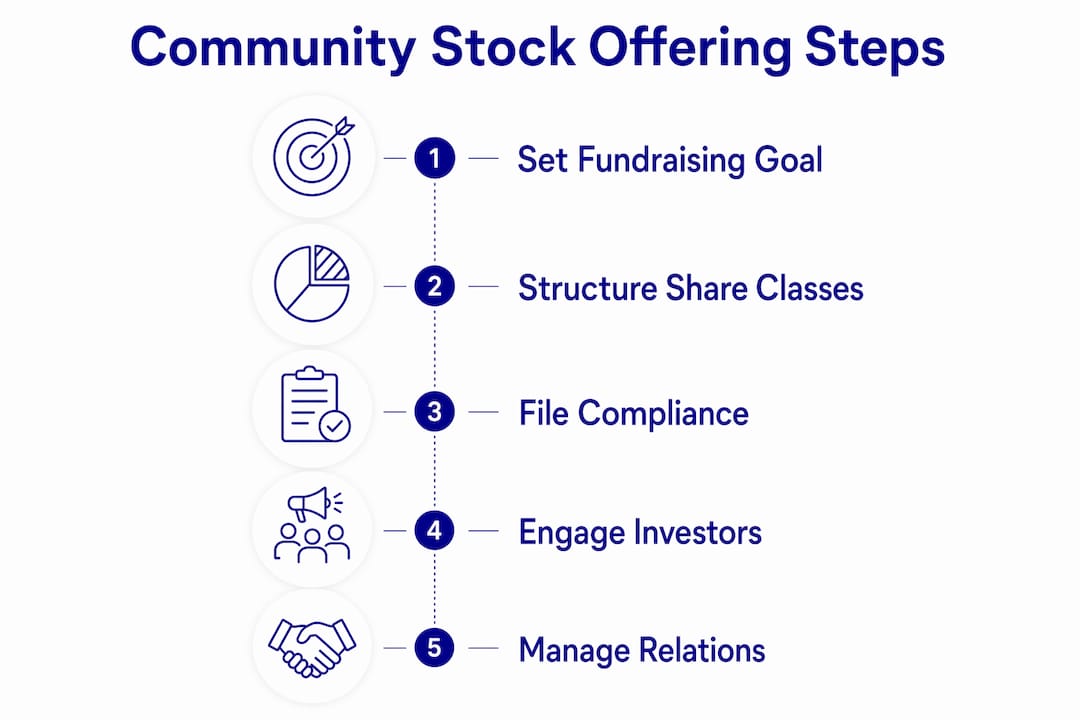
The mechanics are straightforward. A company sets a fundraising target, structures its share classes, files the required disclosures with regulators, and then markets the offering directly to its community. Investors review the offering documents, decide how much to invest, and receive shares in return. The company gets capital. The investors get ownership and, depending on the share class, a voice in governance.
What separates community offerings from a standard IPO is the intent. A traditional IPO targets institutional investors and maximizes valuation. A community offering targets mission-aligned supporters and prioritizes broad participation. Impact campaigns using this model have raised $1.75 million across eight separate rounds in a two-week period, which shows the model can move real capital quickly when the community is engaged.
What types of community stock offerings exist?
Community offerings typically use a dual-class share structure to balance democratic governance with capital needs. Understanding the two main share types is the first step to structuring your offering correctly.
- Voting common shares: Priced low, often in the $5–$500 range, to keep access open to everyday investors. Each shareholder gets one vote regardless of how many shares they hold. This is the one-member-one-vote model used by cooperatives and community benefit societies.
- Preferred non-voting shares: Priced higher and designed to attract investors who want financial returns rather than governance rights. Preferred shareholders receive target dividends before common shareholders, but they do not vote on business decisions.
- Withdrawable shares: Common in cooperative models, these shares are non-transferable and redeemed by the issuing organization rather than traded on a secondary market. They function as withdrawable capital, not tradeable securities.
The dual-class structure solves a real tension. Founders want community input but also need to raise enough capital to operate. By pricing voting shares low and issuing preferred stock for larger financial returns, a business can attract both mission-driven supporters and return-focused investors without giving either group disproportionate control.
Pro Tip: Set your voting share price at the lowest point your compliance budget allows. A $25 minimum opens the offering to far more community members than a $250 minimum, and broader participation strengthens your governance legitimacy.
One critical distinction: community shares are generally not traded on exchanges. Investors who want to exit typically request redemption from the company itself. This means your investors are committing patient capital, not speculative capital. That is a feature, not a flaw, if your business model requires long-term stability.
What benefits do community stock offerings provide?
Community stock offerings give entrepreneurs access to capital without surrendering control to institutional investors. That independence is the primary draw for founders who want to stay true to their mission. Founders who prioritize mission alignment and operational independence gain more from this model than from chasing maximum valuation through venture capital.
The benefits extend well beyond the balance sheet:
- Broader investor base: Selling to hundreds of community members reduces dependence on any single investor or lender.
- Built-in customer loyalty: Shareholders who are also customers spend more, refer more, and advocate publicly for your business.
- Inclusion by design: Equity crowdfunding breaks down barriers that traditionally exclude underrepresented founders from institutional capital markets.
- Mission accountability: Community investors hold you to your stated values, not just your quarterly numbers.
- Long-term capital: Patient investors who believe in your mission are less likely to demand early exits or aggressive growth timelines.
"Community-backed capital builds inclusion and growth without institutional gatekeeping." This is the core promise of the community offering model, and it is why the approach continues to gain traction among founders who want to build businesses that reflect their communities.
The loyalty effect is particularly underrated. When your customers become shareholders, they have a financial reason to see you succeed. They tell their friends. They leave reviews. They show up when things get hard. No marketing budget replicates that behavior.
How do U.S. regulations shape community stock offerings?
U.S. securities law governs every community stock offering, and the regulatory framework you choose determines your investor eligibility, disclosure requirements, and fundraising limits. Three frameworks are most relevant for small business owners.
- Regulation Crowdfunding (Reg CF): Allows companies to raise capital from both accredited and non-accredited investors through an SEC-registered funding portal. Investment limits apply based on the investor's income and net worth. This is the most accessible entry point for community offerings targeting everyday investors.
- Direct Public Offering (DPO): A company sells securities directly to the public without a broker-dealer underwriter. DPOs require state-level registration in most cases and full disclosure documents, but they give founders direct control over the investor relationship.
- Regulation A+ (Mini-IPO): Allows companies to raise up to $75 million per year from the general public with SEC qualification. This framework requires more disclosure than Reg CF but opens the offering to a national audience, not just a local community.
| Framework | Max Raise | Non-Accredited Investors | Secondary Market |
|---|---|---|---|
| Reg CF | $5 million/year | Yes | Limited |
| DPO | Varies by state | Yes | No |
| Reg A+ | $75 million/year | Yes | Possible |
The differences between these frameworks and a traditional IPO are significant. A traditional IPO requires underwriters, exchange listing fees, and institutional roadshows. Community offerings under Reg CF or DPO skip most of that infrastructure. The tradeoff is a lower fundraising ceiling and more direct investor management responsibility.
Compliance is non-negotiable. Every offering requires accurate financial disclosures, and some frameworks require FINRA-registered broker-dealer sponsorship. Share transferability rules also vary. Withdrawable shares in cooperative models are generally not transferable at all, while Reg CF shares may be sold after a one-year holding period. Founders should work with securities counsel before filing anything.
What steps should entrepreneurs follow to launch a community offering?
Launching a community stock offering requires more preparation than most founders expect. The legal and compliance work is only part of the job. The community engagement work is equally demanding.
- Define your mission and investor story. Community investors buy into your purpose before they buy your shares. Write a clear, honest narrative about why you are raising capital, how you will use it, and what investors can expect in return.
- Choose your share structure and pricing. Decide whether you need voting shares, preferred shares, or both. Price voting shares low enough to maximize participation. Set preferred share terms that reflect realistic financial projections.
- Select your regulatory framework. Match your fundraising target and investor audience to the right framework. Reg CF works for raises under $5 million. Reg A+ suits larger ambitions. A DPO fits founders who want maximum direct control.
- File disclosures and get compliant. Work with a securities attorney to prepare offering documents. File with the SEC or your state regulator as required. Do not skip this step or cut corners.
- Market directly to your community. Email your customer list. Host community meetings. Use campaign marketing tools built for securities offerings, not general advertising. Your existing supporters are your first and most important audience.
- Build an investor relations system before you close. Set up processes for handling investor inquiries, distributing voting materials, and managing redemption requests. This infrastructure needs to exist before you have hundreds of shareholders, not after.
Pro Tip: Send a personal email to your top 50 customers before the public launch. Early commitments from trusted supporters create social proof that accelerates the broader campaign.
Entrepreneurs consistently underestimate the ongoing investor relations workload that comes with managing many small-scale community investors. Voting, inquiries, and redemptions require dedicated time and systems. Budget for this before you launch, not after you have 300 shareholders asking questions.Key Takeaways
A community stock offering is the most direct way for a small business to raise capital from the people who already support it, using regulatory frameworks like Reg CF and DPO to stay compliant while keeping institutional gatekeepers out of the process.
| Point | Details |
|---|---|
| Core definition | A community stock offering sells shares directly to local investors, customers, and employees under SEC-regulated frameworks. |
| Dual-class structure | Voting shares priced at $5–$500 give community control; preferred shares attract return-focused investors. |
| Regulatory options | Reg CF, DPO, and Reg A+ each set different fundraising ceilings and disclosure requirements for founders. |
| Investor relations burden | Managing hundreds of small investors requires dedicated systems for voting, inquiries, and redemptions from day one. |
| Strategic fit | This model suits founders who prioritize mission, independence, and community loyalty over maximum valuation. |
Why community offerings are more than a fundraising tool
The framing that most founders miss is this: a community stock offering is not just a way to raise money. It is a way to restructure the relationship between a business and the people it serves. I have watched founders treat these offerings as a one-time transaction and then struggle to maintain investor trust six months later. The ones who succeed treat the offering as the beginning of an ongoing relationship.
The concept of "possibility capital" resonates with me because it captures something that balance sheets cannot. When a customer becomes a shareholder, their motivation shifts. They are no longer just buying your product. They are invested in your survival and your growth. That behavioral change is worth more than the capital itself in many cases.
The governance dimension also gets underestimated. One-member-one-vote sounds idealistic until you realize it protects founders from the kind of investor pressure that forces premature exits or mission drift. Democratic governance is a structural defense against the short-termism that kills mission-driven businesses.
The future of community offerings points toward broader adoption, particularly as equity crowdfunding continues to lower barriers for underrepresented founders. The regulatory environment has become more accessible since the JOBS Act, and platforms built specifically for this model have reduced the compliance burden significantly. Founders who understand this model now are positioning themselves ahead of a shift in how small businesses think about capital.
— Andy
How Directlylisted supports community stock offerings
Raising capital from your community is a serious undertaking, and the compliance, marketing, and investor management requirements can slow down even well-prepared founders.
Directlylisted has processed more than 500 offerings and helped clients raise over $6 billion since 1999. The platform covers the full process, from regulatory filing to investor services and campaign marketing, so founders can focus on building community support rather than managing paperwork. Whether you are running a Reg CF round or exploring a full capital raise under Reg A+, Directlylisted gives you the infrastructure to run a compliant, well-marketed offering without building everything from scratch.
FAQ
What is the difference between a community stock offering and an IPO?
A community stock offering sells shares directly to local investors, customers, and employees under frameworks like Reg CF or DPO, without exchange listing or institutional underwriters. A traditional IPO lists shares on a public exchange like NASDAQ or NYSE and targets institutional investors.
Can non-accredited investors participate in community stock offerings?
Yes. Reg CF and DPO frameworks both allow non-accredited investors to participate, with minimum investments starting as low as $5. Investment limits for non-accredited investors under Reg CF are based on income and net worth.
Are community shares tradeable on a stock exchange?
Community shares are generally not traded on secondary markets. Most are redeemed by the issuing organization rather than sold to third parties, which makes them patient capital rather than speculative investments.
How much can a business raise through a community stock offering?
The limit depends on the regulatory framework. Reg CF allows up to $5 million per year. Reg A+ allows up to $75 million per year. DPO limits vary by state and offering structure.
What is the biggest mistake founders make with community offerings?
Underestimating investor relations is the most common error. Managing voting, inquiries, and redemptions for hundreds of small investors requires dedicated systems and staff that most founders do not budget for before launching.
Recommended
This post is provided for informational purposes only and is not investment advice or a solicitation. See our Disclaimer, Terms of Use, and Privacy Policy.