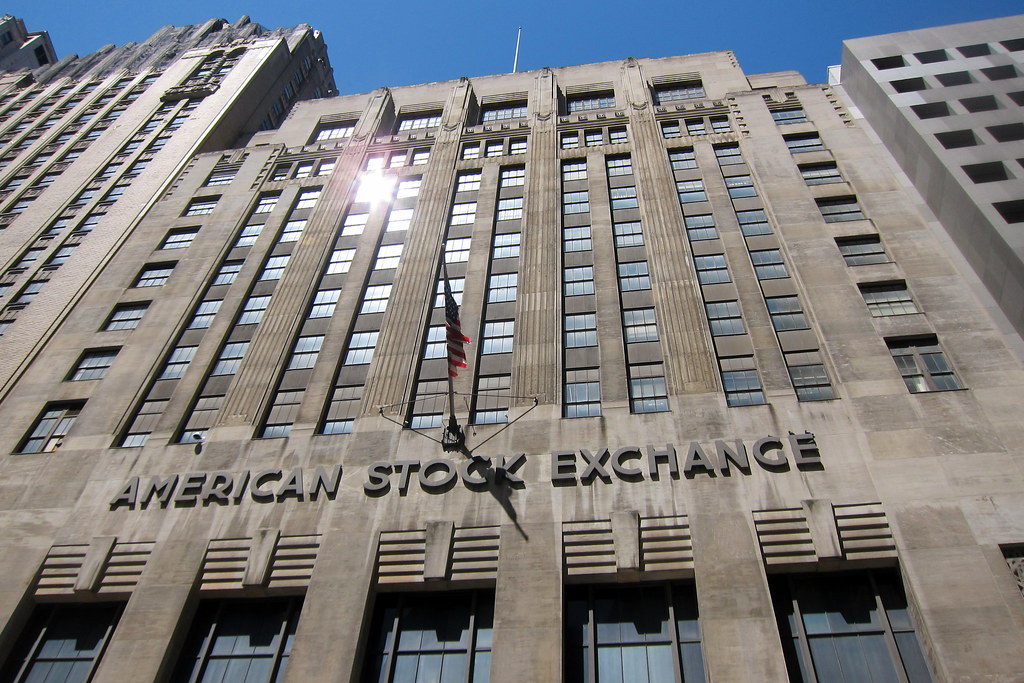
What NYSE American used to be
NYSE American, the old American Stock Exchange, built its identity on serving companies that were too small or too early for the senior exchanges. Its four initial listing standards offered real flexibility. A company could qualify with a lower share price than Nasdaq demanded. More importantly, the public float tests were forgiving about what counted. The market value of publicly held shares excluded stock held by officers, directors, and ten percent holders, but it could include shares subject to resale restrictions as long as those shares sat with outside investors. A company heading into an IPO could also lean on previously issued shares held by non-insiders to satisfy the float requirement, rather than proving the offering itself would create the liquidity.
In practice, that meant a company with a modest raise, a base of earlier private placement investors, and a concentrated register could still find its way onto a national exchange. Plenty of legitimate businesses started that way. So did some of the problem listings that regulators spent 2025 and 2026 cleaning up, and that second group is a large part of why the rules just changed.
What the SEC approved
NYSE American filed its proposed rule change on January 8, 2026, and the SEC approved it with publication in the Federal Register on April 1, 2026. Three changes do the heavy lifting.
First, the exchange now measures the float tests using unrestricted publicly held shares only. Restricted stock no longer counts toward qualification, no matter who holds it. The required market value of those freely tradable shares is $15 million under standards 1, 2, and 3, and $20 million under standard 4, the standard built for larger companies with $75 million of market capitalization or $75 million each of total assets and revenue.
Second, a company listing in connection with an IPO or another underwritten public offering must satisfy the unrestricted share requirement solely from the proceeds of that offering. The old practice of stacking earlier private placement shares on top of a small raise to reach the threshold is gone. The offering itself has to create the float.
Third, the minimum share price moved to $4.00. Standard 4, which previously allowed listing at $3.00, now carries the same price floor as the rest, and the change aligns NYSE American's pricing test with the level Nasdaq applies to most new listings.
Why the exchange moved
None of this happened in isolation. Over the past year, both major listing venues have been tightening the small end of the market in response to a wave of manipulation in micro-cap IPOs, much of it involving foreign issuers with tiny floats and concentrated ownership. Nasdaq proposed its own package in September 2025, including a $15 million public float minimum under its net income standard and faster delisting for companies whose market value falls below $5 million. In May 2026, the SEC approved Nasdaq's rule requiring companies operating primarily in China, Hong Kong, or Macau to raise at least $25 million in a firm commitment IPO. The SEC formed a Cross-Border Task Force in September 2025, and FINRA opened a sweep of small-cap issuers with foreign ties a month later.
The results are visible in the listing statistics. Only 13 micro-cap IPOs reached Nasdaq and the NYSE in the first half of 2026, against roughly 80 by the midpoint of 2025, and the entire cohort raised less than $300 million combined. Regulators concluded that thin, restricted, closely held floats were the raw material of pump and dump schemes, and both exchanges rewrote their rules to require real, freely tradable liquidity on day one. NYSE American's amendments are that policy applied to the venue that historically had the most room to give.
Who feels it first
The companies most affected are exactly the ones NYSE American used to welcome. Development-stage issuers with small market capitalizations. Businesses whose ownership is concentrated in founders, family, and a handful of early backers. Foreign companies, including many Canadian and Asian issuers, whose U.S. float has historically been assembled from restricted private placement stock. For all of them, the question that now decides exchange eligibility is blunt: can the public offering itself produce $15 to $20 million of unrestricted stock at $4.00 per share or better, and can the company hold that valuation once trading begins?
Run the arithmetic and the practical effect becomes clear. A $15 million float requirement at a $4.00 offering price means at least 3.75 million freely tradable shares sold to the public, before any allowance for the total raise a company actually needs for its business plan. An issuer that once planned a $8 million or $10 million offering with the balance of its float coming from converted private placements now needs a materially larger deal, priced high enough to stay above the floor, placed broadly enough to trade. Exchange selection has stopped being a workaround and become a capital formation problem.
Planning a listing under the new rules
In our work preparing companies for exchange listings, the sequencing has shifted noticeably since these amendments took effect. The float test now gets solved before the listing application gets written, and several tools do the solving.
The pre-listing raise has to be sized against the exchange test, not just the budget. A Regulation A+ offering can raise up to $75 million from the general public and, because Reg A+ shares are not restricted securities, the stock it creates counts toward the unrestricted float. That combination makes Reg A+ one of the few structures that builds qualifying float and a broad shareholder base at the same time, which is why it anchors so many of the paths we design on our capital raising platform. Private placements under Rule 506(b) or Rule 506(c) still have a central place in funding the company, and an offshore tranche under Regulation S remains the workhorse for international investors, but the restricted stock those exemptions produce no longer moves the qualification needle. It funds the business while the public offering builds the float.
Anchor investors have moved from helpful to close to essential. Exchanges and underwriters now look for committed capital that supports the valuation and demonstrates genuine demand, and issuers who arrive with anchors identified are clearing review faster than those who plan to find demand during the roadshow. Price durability deserves the same attention. Listing at $4.00 with no cushion invites trouble the first time the market wobbles, and continued listing standards are tightening too. Nasdaq's rule accelerating delisting below a $5 million market value was approved in July 2026 and then stayed by the SEC while objections are heard, but the direction of travel is not in doubt. A listing plan that barely clears the entry tests is a plan for a compliance problem in year two.
For companies weighing venues, one more consequence follows. With the qualification gap narrowed, the choice between NYSE American, the Nasdaq Capital Market, and the NYSE proper turns less on which tests a company can pass and more on fit: sector, comparable companies, index eligibility, and the trading support each venue offers. That is a healthier basis for the decision, but it removes the safety valve smaller issuers relied on.
The uplisting angle
One nuance in the amendments deserves separate attention. The proceeds-only rule applies to companies listing in connection with an IPO or another underwritten public offering. A company that arrives by a different route, such as an uplisting from the OTC markets with an established trading history, is measured on the unrestricted float it already has rather than on what a concurrent offering creates. That changes the strategic value of seasoning.
A company that completes a Reg A+ round today, trades on the OTC markets while its shareholder base broadens and its restricted stock ages out of its holding periods, and then applies to a national exchange in twelve or eighteen months presents a very different float picture than a company trying to manufacture $15 million of unrestricted stock in a single underwritten deal. Neither path is automatically better. The underwritten route is faster where the demand exists, and the seasoned route asks for patience. But under the new rules, the two-step path through the OTC markets has become a serious answer for companies whose registers are heavy with restricted shares, and we expect more issuers to take it deliberately rather than by default.
Questions issuers are asking
Does restricted stock held by outside investors really count for nothing now?
Toward the initial listing float tests, yes. Restricted shares still matter to the company: they represent invested capital, future float once holding periods run, and often the relationships that anchor the next round. They simply no longer help you qualify on day one, which is the entire point of the amendment.
We planned to list under standard 4 at $3.00. What happens to us?
The $3.00 door is closed. Standard 4 now carries the $4.00 minimum along with a $20 million unrestricted float requirement, so a company relying on the old pricing flexibility needs either a higher offering price it can defend or a reverse split executed early enough that the stock establishes a trading history at the new level before the application is filed.
Is Nasdaq now the easier venue?
Not meaningfully. Nasdaq has been tightening on the same schedule, requires IPO companies to meet market value thresholds from shares sold in the offering, and applies a $25 million minimum raise to companies operating primarily in China, Hong Kong, or Macau. The honest reading is that neither exchange wants a thin, restricted, closely held float, and the qualification work is now roughly the same wherever you apply. The venue decision should turn on fit, and the full comparison across listing paths in our FAQ library walks through it question by question.
The bottom line
NYSE American did not close its doors to smaller companies. It raised the price of admission to the level its competitor charges, and it now demands that the admission ticket be purchased with freshly raised, freely tradable stock. Companies that treat the new tests as a financing design problem, solved months before the application through the right mix of public and private capital, will keep listing. Companies that discover the rules at the application stage will not.
If a listing is on your calendar for the next eighteen months, the time to run the numbers is now. Our FAQ library covers the mechanics of every structure mentioned here in depth, our case studies show how completed deals were assembled, and you can book a consultation or see whether your company qualifies and we will map your float arithmetic against the standards that actually apply.
Directly Listed is a technology platform operated by Adamson Brothers Corp. and is not a registered broker-dealer, investment adviser, funding portal, or law firm. U.S. securities law matters are handled in co-counsel with U.S.-admitted securities attorneys. Exchange listing standards and SEC rules change; confirm current requirements before relying on any statement here. Nothing on this page is legal, investment, or tax advice, or an offer to sell or a solicitation of an offer to buy any security.
This post is provided for informational purposes only and is not investment advice or a solicitation. See our Disclaimer, Terms of Use, and Privacy Policy.