A public offering without a roadshow is a method of raising capital from public investors without the underwriter-led marketing tours that define traditional IPOs. The industry terms for this approach are Direct Public Offering (DPO) and direct listing. Both paths let companies access public markets while skipping the costly bank-driven process. Traditional IPOs allocate 5%–7% of gross proceeds to underwriting commissions alone. That figure makes the alternative look very attractive for founders who want to keep more capital in the company. Since December 2020, SEC rules permit direct listings and DPOs as fully legitimate paths to public markets, provided issuers meet strict transparency requirements.
What is a public offering without a roadshow?
A public offering without a roadshow is any registered securities offering where the issuing company does not conduct a bank-organized series of investor presentations before pricing. The two primary structures are the DPO and the direct listing. Each works differently, but both eliminate the underwriter as the central gatekeeper.
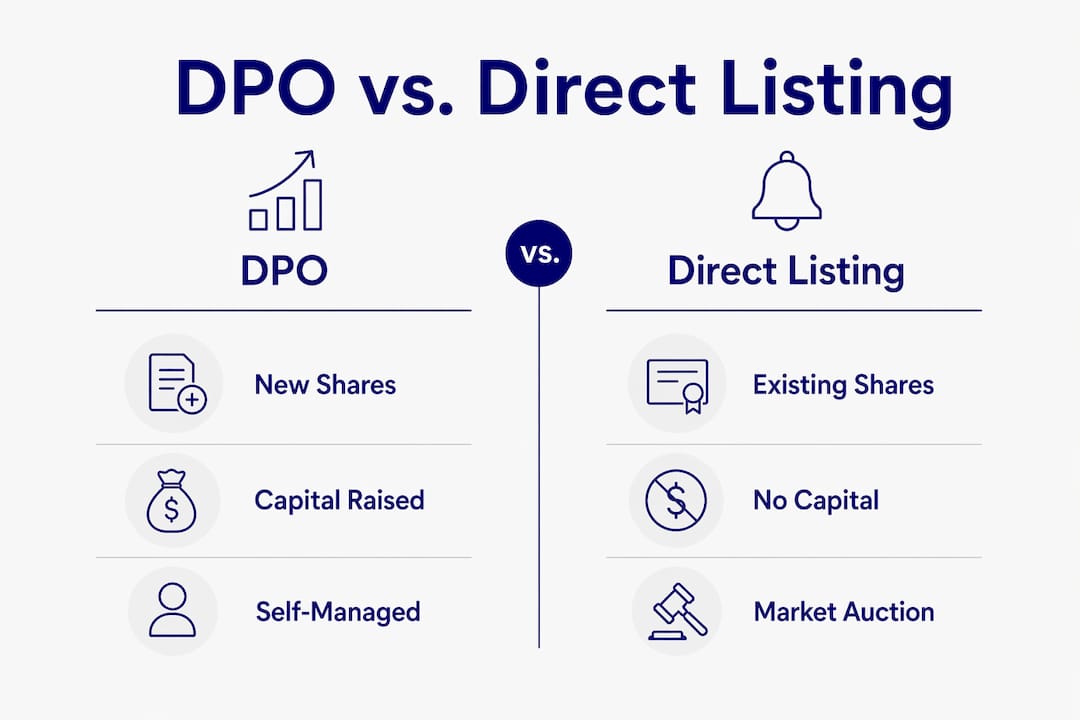
A DPO lets a company sell newly issued shares directly to investors, handling its own marketing and compliance. A direct listing, by contrast, allows existing shareholders to sell their shares on an exchange without the company issuing new stock in most cases. Spotify, Slack, and Coinbase all used direct listings to reach public markets. These examples proved the model works at scale and set a precedent that regulators and exchanges now recognize.

The core advantage is cost. Companies can save between $500,000 and $3,000,000 or more in underwriting fees by choosing a DPO or direct listing. That savings go directly back into operations, growth, or shareholder value. For a growth-stage company, that difference is material.
Does your company qualify for a non-roadshow offering?
Not every company is ready to go public without a roadshow. The absence of an underwriter means the company must carry the full weight of investor credibility on its own. That requires specific conditions to be in place before filing.
The key prerequisites include:
- Brand recognition or an existing investor base. Without a bank marketing your deal, investors need a reason to pay attention. Companies with loyal customers, a known product, or an established community of supporters have a natural advantage.
- SEC registration compliance. You must file a Form S-1 registration statement with full financial disclosures, audited financials, and risk factors. The SEC registration process is rigorous even without an underwriter; the compliance burden does not shrink because you skipped the bank.
- Governance and financial infrastructure. Public companies need board structures, internal controls, and reporting systems that meet exchange standards. These must be in place before listing, not after.
- A direct investor communication strategy. No-roadshow offerings require management to own investor education directly, using investor days, digital platforms, and direct outreach instead of relying on bank-organized presentations.
Pro Tip: Before filing your S-1, build your investor relations infrastructure first. A dedicated IR page, a clear investor FAQ, and a direct contact channel signal credibility to retail and institutional investors alike.
Companies with strong customer loyalty have a structural edge in DPOs. Converting existing customers into shareholders creates a built-in investor base that no bank can replicate. Directlylisted has built its platform specifically around this dynamic, having supported over 500 offerings and helped clients raise more than $6 billion since 1999.
How do DPOs and direct listings actually work?
The mechanics of each structure differ in ways that matter for pricing, liquidity, and control.
Direct listings
In a direct listing, the company registers existing shares for public trading on an exchange like NASDAQ or NYSE. No new shares are created in the standard structure, so the company raises no new capital directly from the listing itself. Traditional IPOs impose a 6-month lockup period on insiders, but direct listings offer immediate liquidity because no lockup is required. That flexibility is a significant draw for early investors and employees who want to realize value without waiting.
Price discovery in a direct listing happens through a market auction on the first day of trading. The exchange's designated market maker sets a reference price based on private market transactions and investor interest. There is no book-building process and no underwriter to set or defend a price range.
Direct Public Offerings
A DPO issues new shares directly to investors, which means the company actually raises fresh capital. The company self-underwrites the deal, sets the offering price, and markets directly to its audience. Advisor costs in a DPO typically run well under the 5%–7% underwriting fee of a traditional IPO, though legal, accounting, and platform fees still apply.
| Feature | Direct Listing | DPO | Traditional IPO |
|---|---|---|---|
| New shares issued | Rarely | Yes | Yes |
| Underwriter required | No | No | Yes |
| Lockup period | None | Varies | Typically 6 months |
| Price discovery method | Market auction | Issuer-set or negotiated | Book-building |
| Capital raised by company | No (usually) | Yes | Yes |
| Underwriter stabilization | None | None | Yes (greenshoe) |
Pro Tip: If your primary goal is raising new capital, a DPO is the right structure. If your goal is providing liquidity for existing shareholders while establishing a public market, a direct listing fits better.
Financial advisors play a supporting role in both structures, handling legal review, SEC filing coordination, and exchange liaison work. They are not underwriters and do not commit capital or guarantee a price. That distinction matters because it shifts pricing risk back to the market.
Step-by-step execution for a non-roadshow public offering
Executing an IPO without a roadshow requires a disciplined sequence. Skipping steps creates regulatory exposure and market confusion.
- Prepare your SEC registration statement. File a Form S-1 with audited financials, a detailed business description, risk factors, and use-of-proceeds disclosure. Full due diligence and accurate disclosures are mandatory regardless of whether an underwriter is involved.
- Engage legal and financial advisors early. Securities counsel, an independent auditor, and a financial advisor experienced in direct offerings are non-negotiable. They manage SEC comment letters and exchange listing applications.
- Build your investor outreach program. Replace the roadshow with investor education events, a dedicated offering website, and digital marketing campaigns. Investor education events are critical for market makers to facilitate efficient first-day trading and prevent zero-volume opening sessions.
- Engage market makers and the exchange. Work with the exchange's designated market maker to establish a reference price and prepare for opening day. For a NASDAQ or NYSE direct listing, this coordination is a formal part of the listing process.
- Execute your marketing campaign. Use digital platforms, social media, email outreach to existing customers, and investor days to build awareness. Directlylisted offers campaign marketing tools designed specifically to replace traditional roadshow marketing with targeted digital outreach.
- Receive SEC effectiveness and launch. Once the SEC declares your registration effective, trading can begin. Coordinate your public announcement, press release, and investor communication for the launch date.
| Execution phase | Key action | Timeline estimate |
|---|---|---|
| Pre-filing preparation | Audits, legal review, board setup | 3–6 months |
| SEC registration | File and respond to SEC comments | 2–4 months |
| Investor outreach | Events, digital campaigns, IR site | Concurrent with SEC review |
| Exchange coordination | Market maker engagement, listing approval | 1–2 months before launch |
| Launch and aftermarket | Trading begins, ongoing IR activities | Ongoing post-listing |
What are the biggest challenges of going public without a roadshow?
Skipping the roadshow removes a safety net that most founders do not fully appreciate until it is gone. Understanding the risks in advance is the only way to manage them.
- Stock price volatility. Without underwriter stabilization or greenshoe options, significant price swings in the weeks after listing are common. Insiders and management must be prepared for this and communicate clearly with shareholders during volatile periods.
- Liquidity risk on day one. Without a bank creating an orderly book of buyers and sellers, opening day trading can be thin. Investor education events before launch directly reduce this risk by ensuring market makers understand the company's value proposition.
- Investor education burden. Management carries the full responsibility for communicating the investment thesis. This is time-consuming and requires a clear, consistent message across every channel.
- Regulatory self-management. Every disclosure, filing, and compliance step falls on the company and its advisors. Errors in SEC filings create legal exposure that an underwriter would normally catch during due diligence.
- Governance engagement with institutional investors. Engaging corporate governance teams of large funds outside of deal contexts builds long-term stability. These teams vote on proxy resolutions and influence how institutional capital flows into your stock.
The mitigation strategy for most of these risks is the same: invest heavily in investor relations before and after the listing. Non-deal roadshows are valuable for public companies even outside of fundraising events because they build trust and improve market perception over time. The companies that succeed with direct offerings treat investor communication as a permanent function, not a one-time event.
Key takeaways
A public offering without a roadshow is a viable, cost-effective path to public markets, but it demands that management replace bank-led marketing with a disciplined, direct investor engagement program.
| Point | Details |
|---|---|
| Cost savings are significant | DPOs and direct listings eliminate the 5%–7% underwriting fee charged in traditional IPOs. |
| SEC compliance is non-negotiable | Form S-1 filing, audited financials, and full disclosures are required regardless of offering structure. |
| Investor education replaces the roadshow | Management must run investor events and digital campaigns to prepare market makers and retail investors. |
| Price volatility is a real risk | Without underwriter stabilization, stock prices can swing sharply in the weeks after listing. |
| Governance engagement builds long-term stability | Proactive outreach to institutional governance teams reduces proxy risk and supports share price over time. |
Why I think the roadshow model is overdue for disruption
The traditional roadshow exists primarily to benefit the banks running it. Two weeks of management time, millions in fees, and a pricing process that systematically underprices shares to guarantee a "pop" on day one. That pop rewards institutional clients of the underwriter, not the company that spent years building the business.
I have watched founders walk away from IPOs feeling like they left money on the table. They did. The book-building process is designed to do exactly that. Direct listings and DPOs shift the pricing power back to the market, which is where it belongs.
The counterargument is real: banks provide price stabilization, institutional distribution, and credibility signals that matter for less-known companies. That is true. But for companies with strong brands, loyal customer bases, or existing investor communities, those services are worth far less than their cost. The question every founder should ask is not "can we afford a traditional IPO?" but "what are we actually getting for that 5%–7%?"
The companies that will succeed with NASDAQ direct listings or DPOs in the next few years are the ones that invest that saved capital into permanent investor relations infrastructure. The roadshow is a one-time event. Good investor communication is a compounding asset.
— Andy
How Directlylisted supports your path to going public
Directlylisted has helped clients raise over $6 billion across more than 500 offerings since 1999, covering everything from Reg D private rounds to full exchange listings on NASDAQ and NYSE.
For founders and executives pursuing a public offering without a roadshow, Directlylisted provides compliance support, capital raise technology, and digital marketing tools that replace the traditional bank-led process. The platform is built to convert your existing customers and community into shareholders, creating a loyal investor base from day one. If you are ready to explore what a direct offering looks like for your company, raise capital your way with a team that has done it hundreds of times.
FAQ
What is a public offering without a roadshow?
A public offering without a roadshow is a registered securities offering where the company goes public without conducting underwriter-organized investor presentations. DPOs and direct listings are the two primary structures used.
How much can a company save by skipping the roadshow?
Companies can save between $500,000 and $3,000,000 or more in underwriting fees by choosing a DPO or direct listing over a traditional IPO, which typically charges 5%–7% of gross proceeds.
Do direct listings require SEC registration?
Yes. Direct listings and DPOs require a full Form S-1 registration with the SEC, including audited financials and complete risk disclosures. Skipping the underwriter does not reduce the compliance requirement.
What replaces the roadshow in a direct listing?
Investor education events, digital marketing campaigns, and direct outreach to retail and institutional investors replace the traditional roadshow. These activities prepare market makers for orderly first-day trading.
Can any company do a direct listing on NASDAQ or NYSE?
No. Companies must meet the exchange's financial and governance listing standards, complete SEC registration, and demonstrate sufficient investor interest to support an orderly market. Strong brand recognition or an existing investor community significantly improves the odds of success.
Recommended
This post is provided for informational purposes only and is not investment advice or a solicitation. See our Disclaimer, Terms of Use, and Privacy Policy.