1. What are the key financial eligibility thresholds for exchange listing?
Financial thresholds form the foundation of exchange listing eligibility criteria. NYSE and Nasdaq each publish specific minimums that companies must clear before an application can advance.
For IPO companies, NYSE requires at least $40 million in market value of publicly held shares. Existing public companies transferring to NYSE face a higher bar: $100 million in market value of publicly held shares and at least 1.1 million publicly held shares. Both categories require a minimum closing stock price of $4.00 at the time of listing.
The $4.00 minimum is not arbitrary. 2026 regulatory amendments raised stock price thresholds specifically to combat market manipulation and improve liquidity. That change signals a broader regulatory trend: exchanges are tightening standards, not relaxing them.

MERJ Exchange sets its own financial floor. Companies pursuing an IPO on MERJ must show revenue of at least $2 million or net income of $250,000 in the most recent fiscal year, plus $1 million in shareholders' equity. These figures are lower than NYSE's thresholds, making MERJ a viable path for earlier-stage companies.
Key financial thresholds to track across major exchanges:
- Minimum stock price: $4.00 at listing (NYSE, Nasdaq)
- IPO market value of publicly held shares: $40 million (NYSE)
- Existing company market value of publicly held shares: $100 million (NYSE)
- Minimum publicly held shares: 1.1 million (NYSE)
- MERJ revenue floor: $2 million or $250,000 net income
Pro Tip: Calculate your public float conservatively before filing. Shares held by directors, officers, or any party owning 10% or more are excluded from the publicly held share count. Missing this exclusion is one of the most common reasons applications stall at the review stage.
2. How do distribution and shareholder requirements affect listing eligibility?
Distribution requirements measure whether a company's shares are spread broadly enough to support a liquid, functioning market. Exchanges treat thin shareholder bases as a red flag, regardless of financial size.
NYSE's standard domestic listing requires at least 400 holders of 100 shares or more. For foreign private issuers using alternate standards, NYSE requires at least 5,000 holders of 100 shares or more worldwide and 2.5 million publicly held shares. That flexibility exists because a broad, liquid home-country market can substitute for domestic distribution depth.
Exchanges also assess average monthly trading volume as a proxy for liquidity. A company with 500 shareholders but negligible trading activity will face scrutiny during the qualitative review phase. Distribution and liquidity are evaluated together, not in isolation.
Common distribution criteria across major exchanges include:
- Minimum shareholder count: 400 holders of 100 or more shares (NYSE domestic standard)
- Foreign private issuer alternative: 5,000 holders of 100 or more shares worldwide
- Minimum publicly held shares (foreign alternate): 2.5 million
- Trading volume: Average monthly volume reviewed as a liquidity indicator
- Geographical spread: Broad home-country market can satisfy alternate distribution thresholds
Pro Tip: Build your shareholder base before you file, not after. Companies that convert existing customers into shareholders through Regulation A or Regulation D offerings often arrive at the listing application with a distribution profile that already meets exchange standards.
3. What qualitative standards and discretionary factors affect listing eligibility?
Quantitative thresholds are the entry ticket. Qualitative review is where listings are approved or denied. Nasdaq stresses that exchanges reserve the right to deny a listing even when every numeric criterion is satisfied, if the company poses investor protection risks.
Qualitative reviews examine company history, management track record, governance structure, and the viability of the business model. Exchanges look for red flags: prior regulatory sanctions, undisclosed litigation, concentrated control structures, or business models that create unusual market risks. None of these disqualifiers appear on a financial checklist.
"Quantitative listing criteria are baseline hurdles; qualitative reviews by exchanges play a critical role in investor protection and market integrity." — Nasdaq Initial Listing Guide
The 2026 amendments tightening listing requirements were driven by concerns over price manipulation and illiquid securities. Exchanges responded by expanding the scope of discretionary review, not just raising numeric bars. That means compliance programs, AML policies, and governance documentation now carry more weight in the application process than they did five years ago.
Areas covered in a typical qualitative review:
- Management background: Prior regulatory actions, litigation history, and relevant experience
- Governance structure: Board composition, audit committee independence, and internal controls
- Business model viability: Revenue sustainability, market risk concentration, and competitive position
- Compliance programs: AML policies, disclosure controls, and SEC reporting history
- Investor protection: Potential for market manipulation, dilution risk, and shareholder rights
4. What are the procedural requirements and timelines for listing applications?
The application process has fixed deadlines that exchanges do not waive. Missing a filing window does not pause the clock. It resets it.
IPO and direct listing applications must be submitted at least 20 trading days before the planned listing date. Other transaction types, such as transfers or secondary listings, may require 15 or 10 trading days of advance notice depending on the exchange and transaction structure. Each exchange publishes its own procedures, and the timelines are non-negotiable.- Confirm eligibility: Complete a pre-application financial and distribution audit against the target exchange's published standards.
- Prepare documentation: Assemble listing particulars, shareholder registers, audited financials, legal certifications, and governance disclosures.
- Engage regulatory advisers: Retain counsel familiar with SEC registration requirements and the specific exchange's listing rules before drafting the application.
- Submit the application: File at least 20 trading days before the target date for IPOs and direct listings.
- Respond to exchange comments: Exchanges typically issue comment letters during review. Slow responses extend the timeline.
- Receive approval and set listing date: Approval is conditional until the exchange confirms all criteria are satisfied on the listing date itself.
Key documentation required in most applications includes listing particulars, a current shareholder register, audited financial statements, legal opinions on share structure, and evidence of compliance program implementation.
Pro Tip: Start the documentation process at least six months before your target listing date. Companies consistently underestimate the time required for AML compliance documentation and audited financial preparation. Late filings reset review clocks and delay launches by weeks or months.
5. How do crypto exchange listing eligibility criteria compare with traditional requirements?
Crypto exchange requirements share the same underlying logic as traditional exchange standards: capital adequacy, operational compliance, and investor protection. The specific rules differ, but the framework is parallel.
Under MiCA, which took full effect across the European Union, crypto-asset service providers must hold CASP authorization and maintain minimum capital between EUR 50,000 and EUR 150,000 depending on the services offered. Trading platforms sit at the higher end of that range. MiCA also requires ongoing compliance programs, AML controls, and disclosure obligations that mirror SEC registration requirements for traditional issuers.
Hong Kong takes a similar approach. Licensed virtual asset trading platforms must maintain HK$5 million in paid-up share capital and HK$3 million in liquid capital from 2026 onward. These thresholds are lower than NYSE's market capitalization requirements, but the operational compliance burden is comparable.
| Requirement | Traditional exchanges (NYSE/Nasdaq) | Crypto exchanges (MiCA/Hong Kong) |
|---|---|---|
| Minimum capital | $40M+ market value of public shares | EUR 50,000–150,000 (MiCA); HK$5M paid-up (HK) |
| Regulatory authorization | SEC registration, exchange approval | CASP license (MiCA); VASP license (Hong Kong) |
| Compliance programs | AML, disclosure controls, audit committee | AML, cybersecurity, disclosure obligations |
| Shareholder/holder minimums | 400–5,000 holders depending on standard | Not publicly specified under MiCA |
| Stock price minimum | $4.00 (NYSE/Nasdaq) | Not applicable |
Crypto firms planning a future traditional exchange listing should treat MiCA or Hong Kong licensing as a compliance foundation, not a ceiling. The governance and disclosure disciplines required for CASP authorization translate directly into the qualitative review criteria that NYSE and Nasdaq apply.
Key takeaways
Meeting exchange listing eligibility criteria requires satisfying both quantitative financial thresholds and a discretionary qualitative review, with 2026 amendments raising the bar on both fronts.
| Point | Details |
|---|---|
| Financial thresholds are non-negotiable | NYSE requires a $4.00 minimum stock price and $40M+ in publicly held share market value for IPOs. |
| Public float calculation is critical | Exclude insider holdings of 10% or more from your float count to avoid application errors. |
| Qualitative review can override numbers | Exchanges deny listings for governance or investor protection concerns even when financials qualify. |
| Timelines are fixed | IPO and direct listing applications must be filed at least 20 trading days before the target date. |
| Crypto rules mirror traditional standards | MiCA and Hong Kong capital requirements follow the same investor protection logic as NYSE and Nasdaq. |
What I've learned about listing readiness that most guides skip
Companies spend months modeling financial thresholds and almost no time on the qualitative review. That is the wrong allocation of effort.
In my experience working with companies preparing for public listings, the applications that stall are rarely short on market capitalization. They stall because the exchange's qualitative review surfaces a governance gap, an undisclosed regulatory matter, or a shareholder register that does not hold up under scrutiny. These are fixable problems. They are just much harder to fix in the middle of a review than before one starts.
The other pattern I see consistently: companies underestimate how much the shareholder distribution requirement shapes their pre-listing strategy. Building 400 qualified holders of 100 or more shares is not a passive outcome of good business. It requires deliberate outreach, often through Regulation D or Regulation A offerings, well before the listing application is filed. Companies that treat distribution as a box to check at the end of the process frequently miss their target listing dates.
The 2026 amendments are worth taking seriously as a signal, not just a compliance update. Exchanges are moving toward stricter standards on price, liquidity, and governance. That trajectory is not reversing. Companies that build their listing readiness around the current minimums may find themselves short when the next round of amendments takes effect.
My recommendation: engage a regulatory adviser who works specifically with exchange listing applications, not general securities counsel. The procedural nuances between a Nasdaq conventional listing and a direct listing are significant, and the cost of getting the application wrong is measured in months, not dollars.
— Andy
How Directlylisted supports your path to public trading
Directlylisted helps companies meet listing qualifications for exchanges without the cost and complexity of a traditional IPO. The platform has supported over 500 offerings and helped clients raise more than $6 billion since 1999.
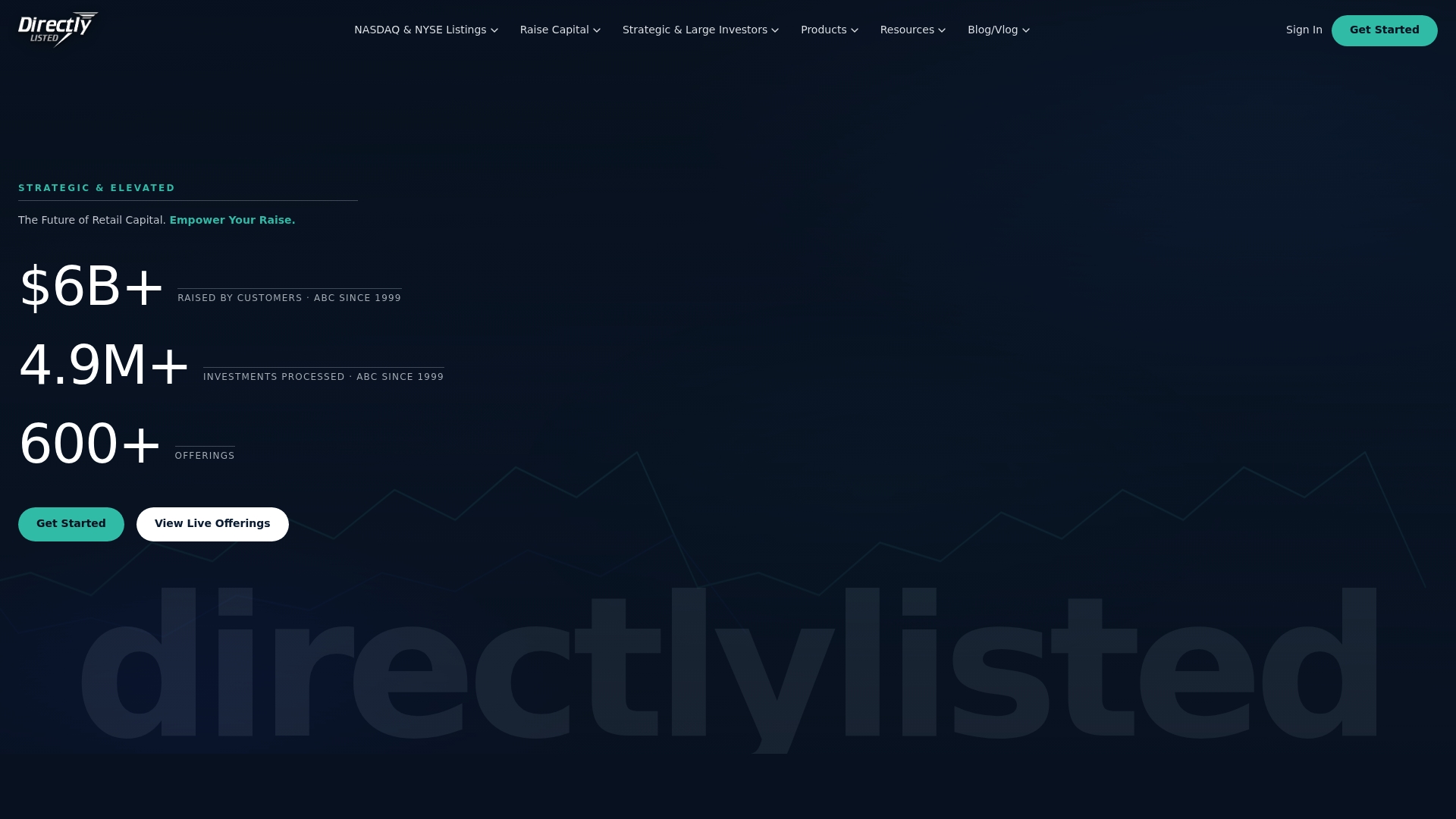
Whether you are preparing for a NYSE direct listing or building the shareholder base needed to satisfy distribution requirements, Directlylisted provides the technology and advisory support to get there. The platform's capital raise technology is built specifically for companies navigating the eligibility requirements of public exchanges. From Reg D rounds to full exchange listings, Directlylisted covers the full path from private to public.
FAQ
What is the minimum stock price to list on NYSE or Nasdaq?
The minimum closing stock price is $4.00 at the time of listing. This threshold was reinforced by 2026 regulatory amendments targeting market manipulation and illiquid securities.
How many shareholders does a company need to list on NYSE?
NYSE's standard domestic listing requires at least 400 holders of 100 shares or more. Foreign private issuers using alternate standards must have at least 5,000 holders of 100 shares or more worldwide.
Can an exchange deny a listing even if all financial criteria are met?
Yes. Nasdaq and NYSE both reserve the right to deny a listing if the company poses investor protection risks, regardless of whether quantitative thresholds are satisfied.
How far in advance must a listing application be filed?
IPO and direct listing applications must be submitted at least 20 trading days before the planned listing date. Other transaction types may require 10 or 15 trading days depending on the exchange and structure.
What are the capital requirements for crypto exchange listing eligibility?
Under MiCA, crypto-asset service providers must hold minimum capital between EUR 50,000 and EUR 150,000. Hong Kong requires licensed virtual asset platforms to maintain HK$5 million in paid-up share capital and HK$3 million in liquid capital from 2026.
Recommended
This post is provided for informational purposes only and is not investment advice or a solicitation. See our Disclaimer, Terms of Use, and Privacy Policy.